
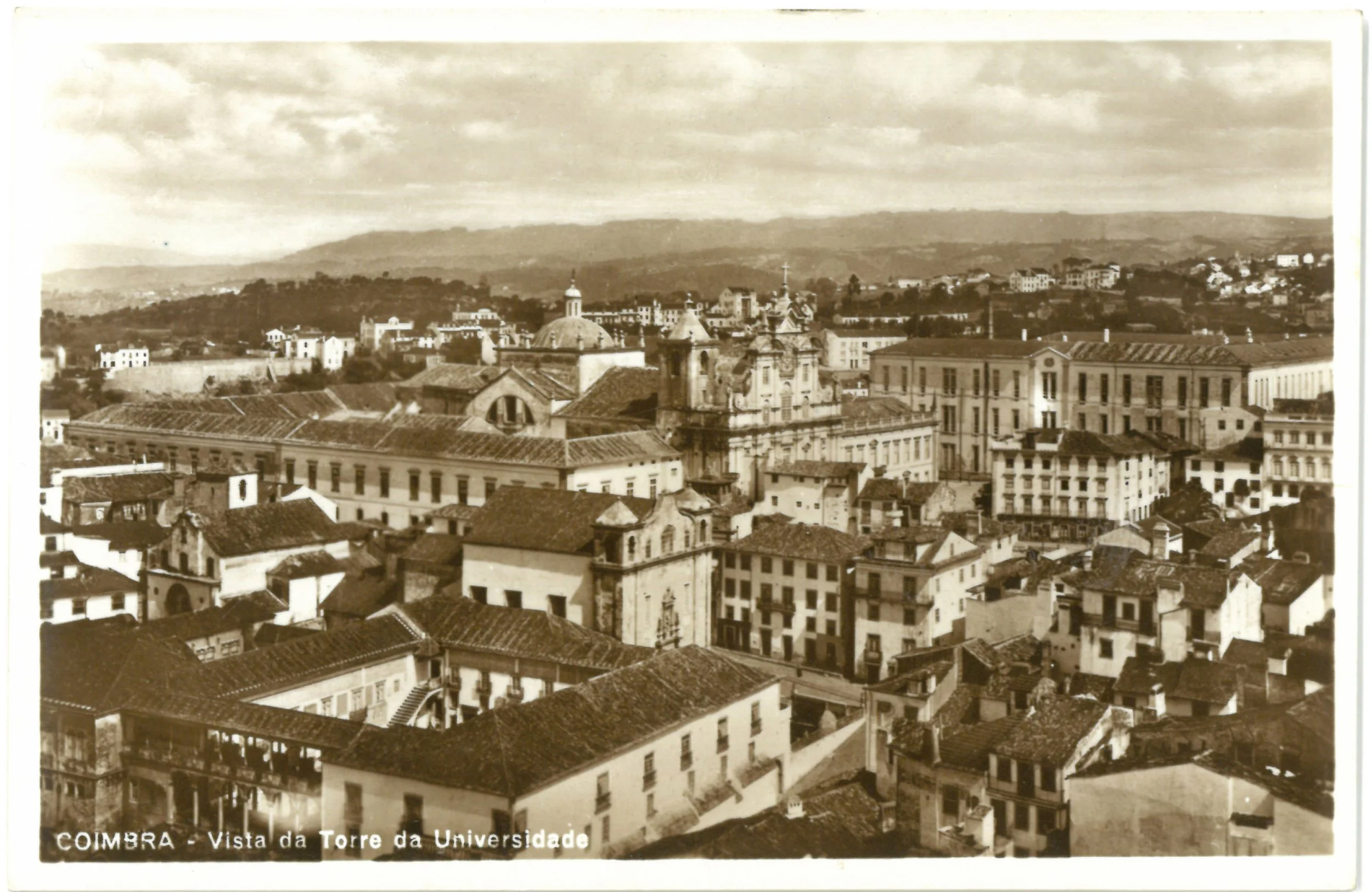
Two postcards with photographs of the University of Coimbra, Portugal.
Coimbra is intertwined with the history of international law in a number of ways, especially known for its contributions to the School of Salamanca. Martín de Azpilcueta, for example, taught there from 1538 to 1555. The university is perhaps most famous in international law circles, though, for its association with the Jesuit philosopher and theologian Francisco Suárez. Born in Granada in 1548, Suárez studied in Salamanca, followed by teaching stints in Salamanca, Segovia, Valladolid, and Ávila. Suárez moved to Portugal in 1597 to take up the chair in theology at the University of Coimbra, publishing his Tractatus de legibus ac deo legislatore in 1612, a work that would prove highly influential for later international legal thinkers such as Pufendorf and Grotius.
The first Jesuits had reached Coimbra in 1542, establishing a college on the hilltop of the then- walled city next to its university. It was here, in the Colégio de Jesus, that Suárez resided and worked while in Coimbra. The modern edifice of what was the Colégio can be seen in the centre of the first of the two postcards (“Vista de Torre da Universidade”) amidst the rooftops of the university buildings of Coimbra’s upper town (Alta de Coimbra).
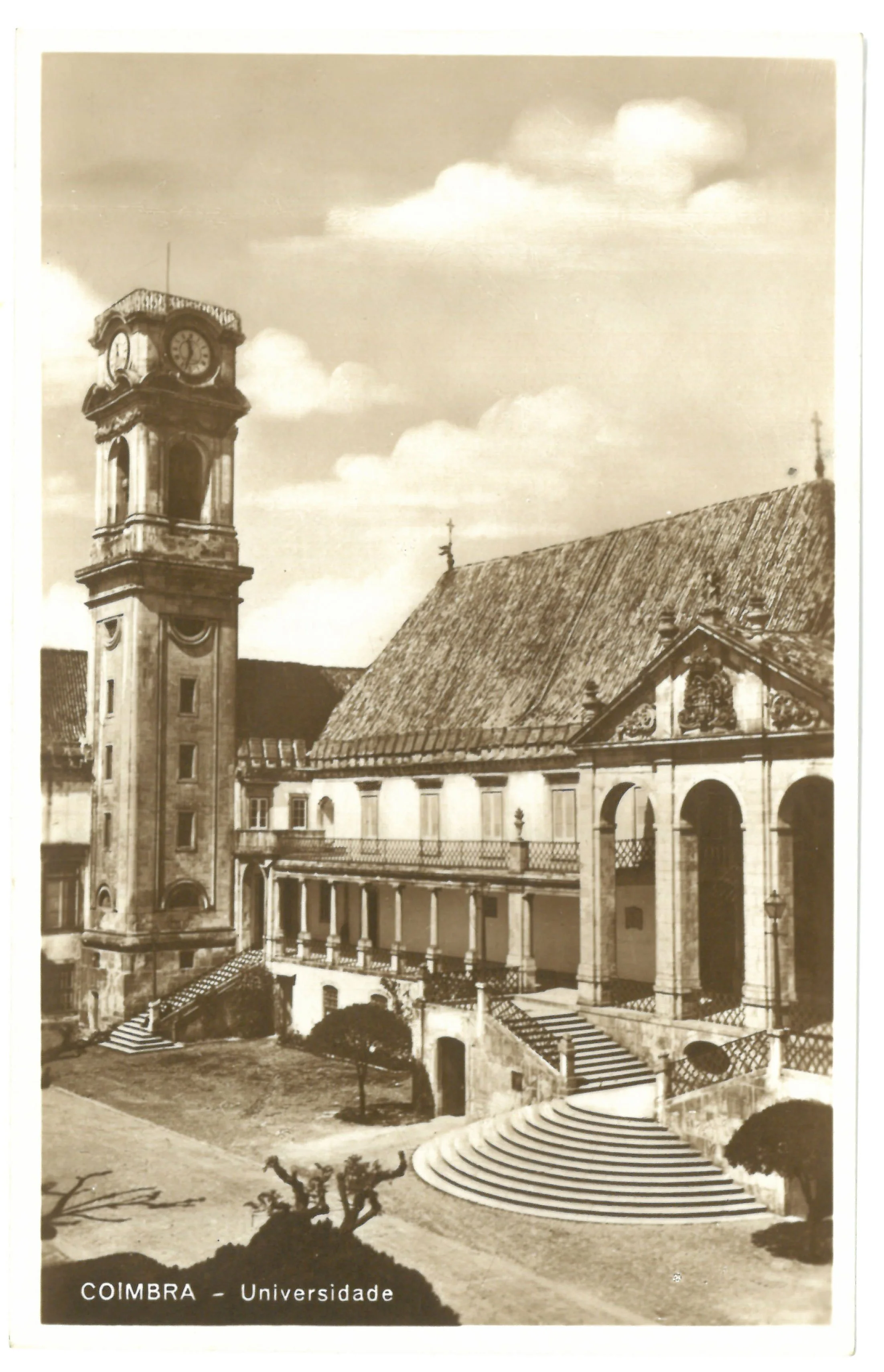
The second postcard (“Universidade”) depicts part of the university’s Paço das Escolas, in which, today, its law faculty is housed. The site, a former royal palace, was occupied by the university in 1544. The university tower, visible in this postcard (and from which the photograph on the first postcard was taken), was built between 1728 and 1733, replacing an earlier 16th-century tower.
Printed in Germany, the two postcards were published and distributed by the Portuguese tobacconist Casa Havanesa, which produced and sold collectible postcards in the early-to-mid 20th century.