
Daniel Ricardo Quiroga-Villamarin
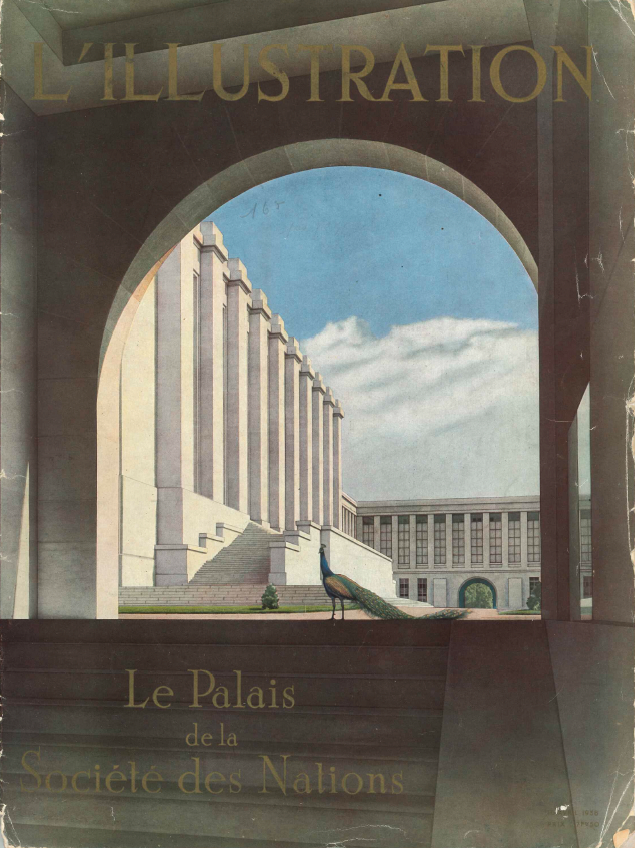
Voici le Printemps ! The Short Spring of the League of Nations
With this sentence, (“here comes the Spring!,” in French), readers of the Parisian magazine L’Illustration were introduced to the theme of its volume 4963, published on 16 April 1938. Fittingly enough, the subject of its cover was an elegant rendition of the newly inaugurated “Court of Honour” of the Palais des Nations of the League of Nations —including a cameo of the, still famous, peacocks that graze in its grounds (see Figure 1). The journal, which claimed to be an hebdomadaire universel, brought topics of interest to a cultivated readership since 1843. Its distinctive feature was its use of colour illustrations —and, eventually, photographs— making it a pioneer form of medium in European and global history. It included cartoons, advertisements, and essays on current domestic and affairs —offering different options of subscriptions for readers both in France (including its colonies) and the rest of the world. While some of its volumes are freely available online today, most of them are reserved for those holding a paid subscription of their own, vast, collections. Vol 4963 is not open to free consultation, and in what follows I provide an overview of how it offered a glimpse of interwar international law (and of the League of Nations, in particular) on the basis of an exemplary which I was lucky to find —one day; by chance— in the marché aux puces de Plainpalais in Geneva. Readers in the Third Republic were, of course, drawn to the subject matter of this specific volume. Given France’s active involvement in the design and everyday operations of the League of Nations (indeed, at the time of publication, the French national Joseph Avenol even served as the second Secretary General of this international organization), Parisians had long followed its developments. Since 1920, the League had been operated in somewhat improvised conditions out of a refurbished hotel. But the creation of its own Palais des Nations (“Palace of Nations,” in French) had been the culmination of a decade-long effort to provide this institution for a room of one’s own, so to say.
The League, explained the hebdomadaire, was the embodiment of the great hopes placed in the Treaty of Versailles to maintain peace in Europe after the ravages of the Great War. The lion’s share of the volume is reserved to an article by the famous Swiss novelist Hélène Pittard (using her nom de guerre Noëlle Roger), who provided an extensive overview of the architectural and design history of the building. She concludes that its beautiful site might teach men the “sweetness of peace and the prestige of the law if they were able to understand its word-less message” (p. 410). After years of precarity, here comes the much-awaited springtime of the League of Nations.
Her lofty tone was counterposed, perhaps, by a more sombre article the controversial author Bernard Faÿ, disparaging the United States for its lack of engagement with the League —and with pressing issues in international affairs, more broadly. The tone of the journal continued turning increasingly sour, as it covered domestic affairs and the dislocation of Leon Blum’s Front Populaire (in a relatively short noted by Robert Lambret). And this timbre was further compounded by the coverage of two other pressing events in Europeans relations: the Anchluß of Austria (p. 419) and the final days of the Spanish Civil War (p. 420-421). France, as it is well known, have found itself on the “losing side” of these two developments. Some months later, it would one year late find herself —and most of the globe— in what we now call the Second World War. A conflagration that, of course, also rang the death kneel for the League of Nations —and engulfed Europe, and more of the world, in years of sombre autumn.
Volume 4963 of L’Illustration provides a snapshot into a particular week in which the both the winds of Spring and those of the coming storm were felt strongly at the League of Nations in Geneva. Now that similar wind currents approach the United Nations in New York City, we have much to learn about the terrible thirties —for only alternative to the spring of nations is, today, the bleakness of nuclear winter.